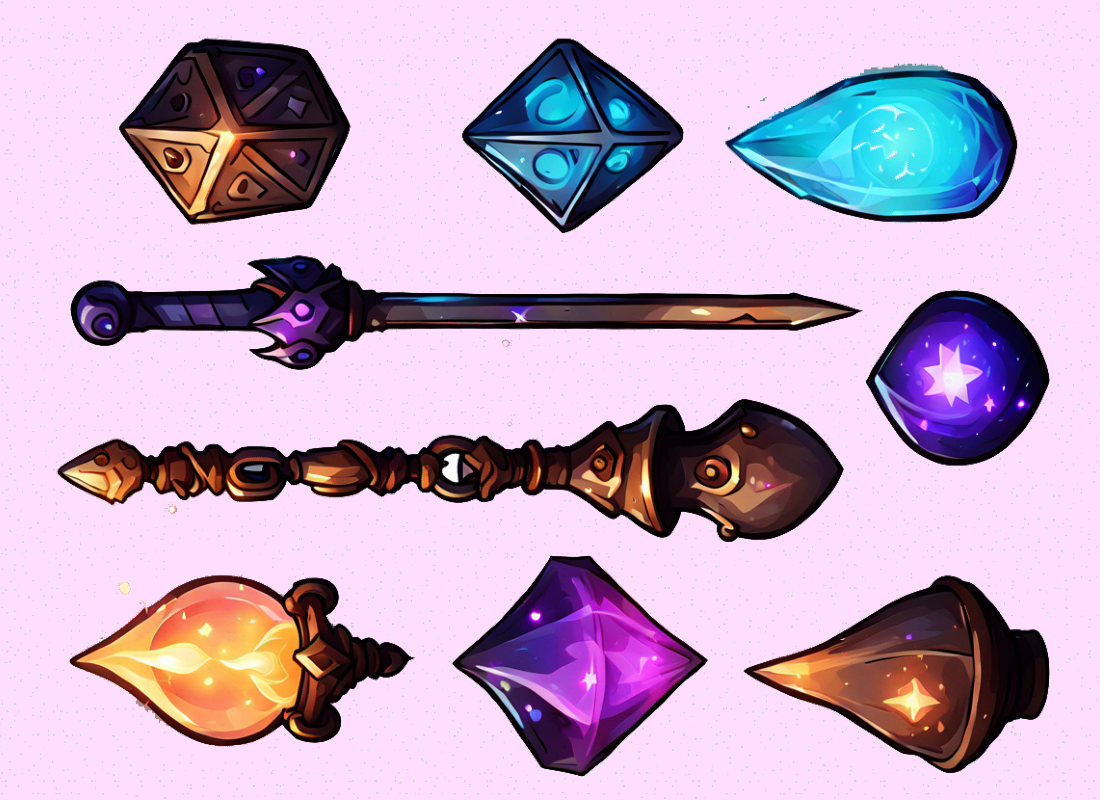
Magic items are cool. Magic items break the game. Players love them. Players love them too much, and they overshadow other aspects of play.
Balancing the best and worst aspects of magic items has been a challenge to TTRPG designers for years. Consider how different games have tried:
- D&D3E put up three guardrails: It tied item value to recommended wealth each PC should have per level; that put a ceiling on what a PC could have. It put an xp cost into item creation; so that item creators would not flood the game with items that cost less to make than to buy. And it limited items to certain body slots, which cut down on stacking.
- Pathfinder tore down the experience point cost guardrail, making item creation a lot more valuable. Essentially, pay a one time-fee (a feat or two) and get a permanent 50% discount on magic items. And by adding the capability to add powers to an item, and to make items "slotless" for an added cost, the stacking restriction imposed by the slot system became a lot weaker. Pathfinder really pushed the needle in favor of the Christmas-tree PC with doodads and geegaws hanging from every branch.
- D&D Fifth Edition really trimmed the Christmas-tree abuses by imposing just three slots, with its attunement system. You (a PC) can use a relatively large number of slotless items (those that do not require atunement) without restriction, but you only get to use three of the best items. Also, 5E explicitly urges game masters to track the number of items they hand out in total, and it offers guidelines on how many is too many.
- Five Moons lets you have five items total, period. Items are ranked by level (1-20) and five power-usage categories, from "weak and consumable" to "self-powered and permanent." Items may be traded, not sold.
What I like about the above options are: paying experience points for items, paying gold for items, and limiting number of items per character. For Labyrinths & Liontaurs, I'm going back to 3E's body slots limitation, along with wealth by level guidelines. And although I really like the idea that you have to put xp into magic items, rather than the creator having to pay the xp cost, it is the user who should have to pay. That way, the character who benefits from using the item bears the cost.
For permanent items, I also like the Five Moons idea that items have power-rankings — in L&L, permanent magic items come in tiers, just like PCs. Tier I items actually cost no xp, and they generally cost no more than a couple thousand gold. They typically give a +1 to attacks, damage, saves, or AC, or +1 to an ability score. These are "minor magic items," as they are called in 3E. Higher tier items are just Tier 1 items that you have linked to and put xp into. These items take a larger portion of your WBL, but if you sell them, they are only Tier 1 items to anyone else, so you only get the Tier one gold piece value on sale (and only half price at that, since you are no merchant.
So you cannot buy higher tier permanent items. Instead, when you soul-link an item, you pump value and xp into it, and that makes it more powerful. The Tier 1 ring you picked up at level 4 becomes more powerful once soul-linked at level 6, and offers more power at levels 11 and 16.
Consumable items can be quite powerful, and quite costly, and do not require attunement via soul-link. That advantages them vis-a-vis other items (especially since they require no xp to make and you can have as many as you want), but the disadvantage is that having used them, the gold (or equivalent) spent on them is gone. Now, using a "Wealth By Level" system makes tha cost less painful, since you (the PC using consumables) know that you will recoup the gold later when the game master brings you back up to your expected wealth. To help guard against this attitude, consumable items still count against a PC's WBL to the tune of 1/100th the original value, even after you consume them.
A drunken Potion of Alter Self counts as 2 gp against WBL, and an exhausted Wand of Fireball counts as 108 gp. Eventually, this amount will count as a trivial expense and fall off your inventory. Until then, it still has a cost that counts against your total wealth.
When you create a consumable or Tier 1 item, the gold cost is half the book value. That seems a fair price for the feat you take to gain the ability to make them.
Art purchased from deviantart.com.

