I'm indebted to Aaron Marks over at Cannibal Halfling Gaming for his March 2026 article, "Breaking Down Random Generation." It's an excellent read, and it inspired my thoughts in this screed.
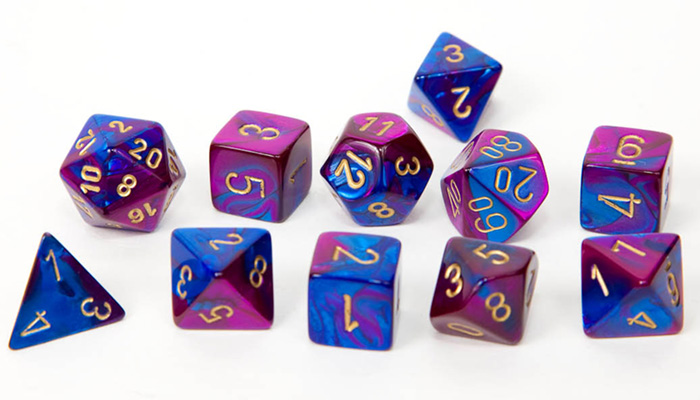
I've always loved rolling dice. There's the visceral physicality of picking up dice, rolling them in your hand, and then throwing them. The click and clatter. The beauty of the Platonic solids. The way they are like gemstones, collected and hoarded as a dragon gathers treasure. Players build towers with their dice, sew special dice bags of leather or velvet, build beautiful felt-lined dice trays for rolling, and, of course, buy way more dice than they will ever need.
And gamers invest karmic energy in their dice, giving them emotional, narrative, and symbolic weight during gaming sessions. They "punish" their dice for bad rolls, putting them in a time out, or scolding them. They have to "warm up" their dice before an important roll. They don't let anyone else touch their dice. They have favorite dice and cursed dice, rituals and superstitions.
For a game designer, rolling dice is a tool for definition and for resolution. Yes, a game master could just arbitrarily define a world, and players could define their characters, by fiat or point allocation; they can resolve conflicts and uncertainty without randomness. To generalize unfairly, I find these diceless games to be sterile and soulless. There is just something fascinating about rolling dice, generating random numbers, to figure out what is what in a roleplay game. It's exciting to find inspiration in the chaos of random rolls. Why is your fighter so wise? Why does the swamp border the desert? Why do 20 kobolds suddenly pop out of the bushes? Don't say, "Because the dice rolled it." The fighter is wise because he has keen eyes and intuition. The swamp is sourced in a magic spring. The kobolds are fleeing a band of ogres! We create meaning, we tell stories, from the results the dice offer us.
The Problem of Fairness
But the disadvantage of randomly rolling is clear: Sometimes the dice are not fair. Sometimes they are too good, and your results are too lucky. You critical thrice in a row. You rolled an 18/00 strength AND you got psionics! (The old 1E grognards will know what that means.) But players do not much complain about such good luck, even when great rolls are not really fair to the other players.
But players DO complain, loudly and righteously, when they are too unlucky.
Even if they do not complain, an unfair roll can still ruin a game — or at least, a session or a character. Take the story of my 1E ranger, Armath, who could only die on a d100 roll of 99 or 00. You can guess what happened. I told that story in 2023. (Actually, Google informs me that I also told the same story in 2006.)
And sometimes the game master allows dice roll results to wreck an adventure, or to hurt the game. Do the rules include tables for random loot drops? And do those tables allow the very small chance of, say, finding an artifact? And when you are running a game under those rules, and you follow the dice, and you end up giving your low-level party an item that wrecks game balance, makes the party invincible, and elevates the item's owner to the center of the action — well, if that happens, the damage to the game is not exactly fair.
In high school, when I was young and stupid, I spent weeks creating a custom homebrew D&D module. It was a layer of the Abyss ruled by a snake-demon, "Apep." Which I ripped off from Ancient Egyptian mythology, BTW. Near the start of the module, I put in a scrying/teleport room, from which you could randomly peek at some place on the layer, and then step through to go to it. I had intended to use that to get the party lost and then exploring, if they chose to step through. I made a table to determine randomly the location revealed by the scrying device. And being an idiot, I included a very small chance that the device would reveal Apep in its evil glory, ruling in its throne room. On actually playing the module, the dice spoke, the device revealed Apep, the party stepped through, they defeated the demon, and the module was over — skipping something like 90-plus percent of the module over which I had labored.
Were I not a young idiot, I would not have included the chance to teleport to Apep, or I would have rerolled the scry result, or I would have had Apep teleport out after one round, or SOMETHING! Ah, well, like we said back in the day, Ohwa Ta Foo Lie Wuzz! But the basic point remains: A major drawback of using dice rolls is that sometimes the dice are singularly unfair.
During Covid, I played in a Discord game run remotely by my nephew. We all rolled randomly to generate PC stats, and after playing with point-buy ability score generation methods for decades, I still recall my unhappiness at rolling poorly, especially when I saw other players rolling great stats. Fortunately, I had grown up a smidge, I shrugged that off, and went on to very much enjoy "Unka," my gnome arcane trickster/wizard, whose Wisdom of 6 really came to define the character!
However, even though grown-up me managed to find the fun in bad dice rolls, for many RPG gamers, playing a "flawed" or "crappy" character sucks the joy out of the game. Back in high school, we even invented our own house slang for a character fatally weakened by bad rolls; such a character was "poodly" (the adjective) or "a pood" (the noun). Nobody wants to play a pood.
Two Kinds of Rolls
In TTRPGs, there are frequent rolls you make over and over, and there are rare rolls you make once, or only at lonely intervals. Frequent rolls are made many times over the course of an adventure: rolling for attacks, skill checks, saving throws, etc. Rare rolls are made just once in a PC's career: rolling for ability scores, hit points, starting wealth, etc. There are different ways to mitigate unfairness in both kinds of rolls.
Character creation looms large in the category of rare rolls. Your PC's stats are definitional; the results are felt in every adventure. Aaron Marks discusses this at length, and while he sees real value in using dice to create characters, he urges the industry to do better. He concludes, "design with an eye towards randomness needs to evolve beyond basic random rolls that will almost always punish at least one player with an arbitrarily worse character." He discusses some ways that games have pushed forwards: "When you look at randomness that works, that still feels good for players, it employs a combination of numerical mitigators and statistical extensions. Mitigators are tricks like ... using 4d6 drop lowest as a dice mechanic to skew the results positive, or giving other bennies like swapping out a low stat for a higher one. Statistical extensions are mechanics which stretch the randomness of a character out over more and more rolls, making it more likely that the net results revert to the mean." He also mentions that WFRP offers off-ramps to almost all of their random generation options, and Dungeon Crawl Classics encourages players to use funnel character creation.
Let me here brag on how my own game, Labyrinths & Liontaurs, defuses the disadvantages of unfairness in rare rolls. Ability scores are easy to roll: There are six ability scores, so roll six dice. Roll 1d8, 1d6, 1d6, 1d6, 1d4, and 1d4. Add all your rolls together and subtract from 34. Those are your lionheart points. Add each individual number rolled to 9. Those are your six base ability scores. Arrange as you prefer.
"Roll One Die and Add to 9" means that no PC will have a stat below 10. No bad scores. No penalties due to low scores. Rolling mostly d6s and d4s means that only 1 in 8 PCs starts with a 17 (if you roll an 8 on your d8). Stats generally start on the low side. But even so, it is possible that your stat array could be 10, 10, 10, 10, 10, 10. That's where lionheart points come in. These points (34 minus the total of your rolls) renew every day, and the lower your stats, the more of them you get. The poodly all-10 PC starts with 28; the godlike 17-15-15-15-13-13 PC starts with none.
In L&L, the same mechanic applies to hit dice rolls and starting wealth. The idea is to mitigate the effect of unfair rolls (to "soften" them, Aaron Marks would say), by compensating players who roll poorly, and by penalizing those who roll especially well. This way, the rare rolls still have meaning and weight, but they can't wreck a character.
On the other hand, frequent rolls happen so often that the cumulative effect is to trend toward the mean. The problem is self-correcting. Roll enough times, and you will see good rolls and bad in equal numbers. Board gaming's ne plus ultra here is Titan, a wonderful game I have blogged about before (here and here). In Titan, the number of attacks made by a monster is equal to their hit points. A centaur with 3 hp rolls 3d6 to attack; an 18 hp serpent rolls 18d6. Rolling so many dice teaches statistics like a college prof: That centaur swings his ax, with each die hitting on each roll of 2+, so with 3 attacks, does 2.5 hp damage on average. The serpent, in retribution, rolls 18 dice, looking for 6s, inflicting 3 hp damage on average. You roll a lot of dice in Titan, and over time, the good and bad rolls cancel out.
Still, even rolling many dice over the course of a PC's career in a TTRPG, it can still come down to that single important d20 roll to, say, save versus death. And that's where lionheart points come in. You can use your points to add a bonus to the roll, or add a smaller retroactive bonus, or reroll a failed die, or to "cheat death" — like Pathfinder's hero points. In this way, the compensation granted for unfair rare roll results is used to soften the worst of the frequent rolls. That seems elegant to me.


.jpg)