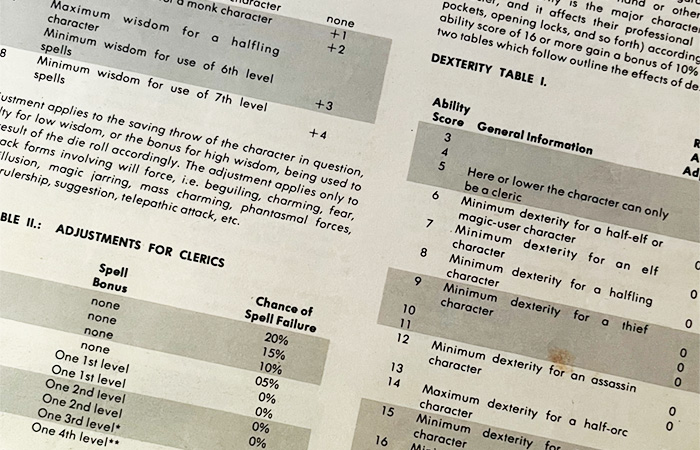
First and Second Edition Dungeons and Dragons did a poor job with ability score bonuses. First off, actual modifiers only kick in at high scores. A 15 Con gives you +1 hp/die. A low score of 6 gives you a -1. But from 7 to 14, nada, zip, +0. Designing his own Five Moons game, Sean Reynolds says, "I don't want to go back to 1E/2E AD&D's system where the difference between an 8, 10, and 14 was essentially "nothing" for most characters; one really great thing about 3E as a change from 2E is it made most of the mid-range ability scores actually worth something instead of being a dead zone before you got to the worthwhile ability scores."
Third Edition *did* get that right! You get a +1 at 12, +2 at 14, +3 at 16, etc. That's way better than +0 from 9 to 14. But what about at odd numbers? 10 to 11, 12 to 13, makes no nevermind. In a game that adds +1 every four levels, this leads to odd results, like putting your odd numbers where you intend to devote your upcoming +1. And magic item stat boosters coming in even increments: +2, +4, +6. And racial mods also in increments of +2. That all leads to metagaming and stat inflation.
 When I pondered the granularity of this "only benefit on even numbers" problem, I was reminded of the way Dexterity works in the AD&D Players Handbook. There is a Defensive Adjustment that starts at +1 for a 15 Dex, and a Reaction/Attacking Adjustment that starts at +1 at a 16 Dex. That inspired me to stagger bonus advancement in Labyrinths & Liontaurs. Combining the idea that a large "dead zone" is bad with staggered advancement led me to this:
Ability Score | Active Modifier (Column A) | Balance Modifier (Column B) |
|---|
(Changes at odd numbers) | (Changes at even numbers) |
|---|
10 | 0 | 0 |
11 | +1 | 0 |
12 | +1 | +1 |
13 | +2 | +1 |
14 | +2 | +2 |
15 | +3 | +2 |
16 | +3 | +3 |
17 | +4 | +3 |
18 | +4 | +4 |
19 | +5 | +4 |
20 | +5 | +5 |
Note that player characters never start with ability scores less than 10; only one in eight has the option of starting with a 19. Later, a score above 20 is rare, and above 30, pretty much impossible. Also, note that the game incentivizes balanced stats: at character levels 5, 10, 15, and 20, you can permanently add +1 to your highest score, or add +1 to a lower score and also raise your lionheart point maximum by two points.
However, unfortunate circumstances could lower an ability score, and certainly various non-player characters, monsters, and other things can have scores well above and below a PC's normal range. Modifiers for higher and lower ability scores can be easily extrapolated from the table.
But what is the difference between "active" and "balance" modifiers? How do you know which applies to what modifiers? For a long time, I just assigned modifiers without rhyme or reason to "Column A" or "Column B" — but I came to understand that I was making it harder on my players, who would have to memorize which applied to which, or constantly be looking it up. Then I had a revelation.
If you add a modifier to a d20 roll, like rolling an attack, a save, or a skill check, then use the modifier in Column A, the Active Modifier.
If you are using a modifier for any other reason, like damage bonuses or bonus spells per day or spell DCs or special ability uses per day, then use the modifier in Column B, the Balance Modifier.
The simplicity here is that to know which modifier is the right one, just ask if you are rolling a d20 and adding a mod. If so, use the Active Modifier. Otherwise, use the Balance Modifier. This is elegant and easy to recall or figure out from the general rule.
The two big problems in traditional 3-18 ability score systems are (a) the tendency to create dead zones in the middle ranges where stats don't much matter, and (b) the granularity problem of only bumping up ability score modifiers at even numbers. L&L solves those problems by offering meaningful advancement at all ablity score values and offering staggered bonuses so that some benefit derives from advancing even one point. The use of staggered bonuses demands a reason for some to change at odd values and the balance to change at even numbers. L&L promotes Active Modifiers at odd numbers that are exclusively used to modify d20 rolls made by the player. Balance Modifiers are used for all other purposes.