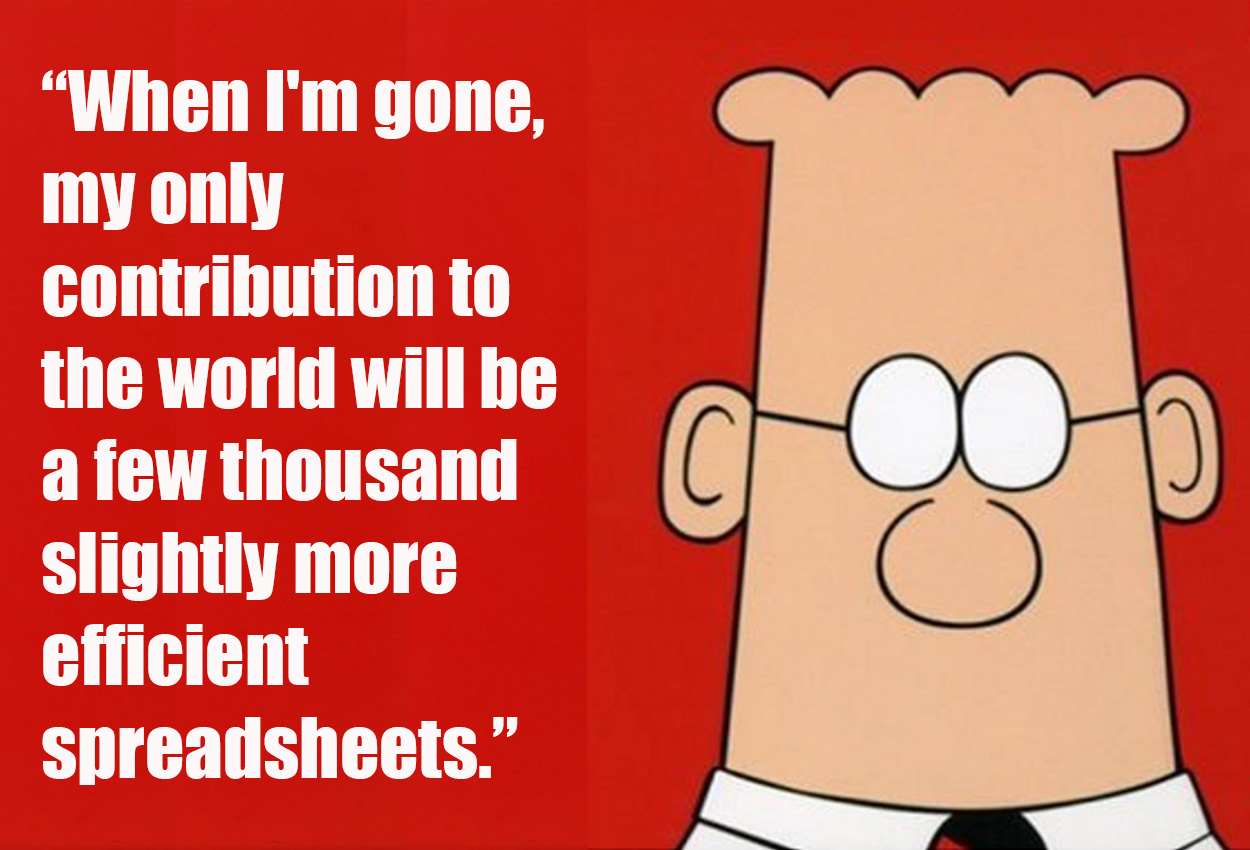
Scott Alexander, an insightful blogger, recently wrote about Scott Adams, the creator of Dilbert. He followed that essay up with feedback from readers and more thoughts on related topics.
In his follow-up, Scott Alexander writes:
All nerds must eventually realize they're not going to immediately dominate everything by intellect alone. This isn't because intellect isn't great, it's because 1) it's only one of many skills, and 2) you probably aren't even the person with the most intellect. Again, every mildly-talented person has to face this realization, whether it's a nerd realizing he won't be the next Einstein or a jock realizing he won't be the next LeBron.
If someone deals with this using denial (one of Freud's maladaptive defenses), you get the nerd who says no, I really am the next Einstein, ie a crackpot .... If they deal with it using reaction formation (another of Freud's maladaptive defenses), you get the self-hating nerd ....
If they just deal with it maturely instead of spinning up maladaptive defenses against it, they're a nerd who is hopefully good-natured and accepting of their nerdiness, and hopefully does some good work in some specific small area, and changes the world in some specific small way (or some very large way, if they can work together with other people and get lucky).
Boy, that hits home with me.
When I was a kid (I'm talking elementary and high school, back in the '70s), I had not yet realized I was "not going to immediately dominate everything by intellect alone." I was smart, a bookworm, a D&D nerd, and an obsessive. Just look at that beer bottle cap collection my brother and I had (about 800 different caps, IIRC). I befriended the local librarians, of course, volunteering at the library, recommending books to the librarian, instead of the other way around. And I remember when a very nice librarian asked me if I had ever considered becoming a librarian. "A librarian?" I said haughtily. "I'm going to be a doctor!"
God, I hate that snotty, stuck-up kid. What an ass he was. I would have had a very happy life as a librarian.
Instead, I headed off to a tech school, majored in biology, and fell on my face. I was, as Scott Alexander says, a mildly talented person who had to face this realization: I was not all that smart, and I did not have the other skills I needed to do well in a challenging environment. When I realized this, I thought my life was over, and I got some counseling. And muddled through. Eventually I found my way into journalism, where my actual skills, with words, were enough to earn a decent living.
But the point is, I think I did manage to avoid the Scylla and Charybdis of crackpottery and self-hatred, per the above. I like to think I have managed to find my way to being hopefully good-natured and accepting of my own nerdiness, and, hopefully, I've done some good work in some specific small area, and changed the world in some specific small way.
What's the small, specific way that I've managed to change the world? For one, wemics. I think I really do have "the best darn wemic site on the Internet," a catchphrase I have been using (more or less self-deprecatingly) for 30 years. I do think that public awareness of wemics is a bit higher among game nerds than it might have been without me. Being the best in the world at a trivial thing is axiomatically trivial, and any number of people could have made better wemic sites ... but they didn't.
Another small, specific way — maybe my indie d20 TTRPG will be that. At least, I anticipate feeling proud of having made it, once I finish it. And perhaps someday I'll write some small decent fictions. Maybe.
Here, much closer to the end of my life than to the start, I can't help thinking about legacy, about mortality. I suppose "good-natured and accepting," with "some good work in some specific small area," is not a bad legacy. At least, it's a comfort to think so.