Google Scholar told me about a mention of a lion-centaur in an old academic manuscript. I tracked down the full text, thanks to the wonderful folks at archive.org. In "On the true nature of the Contorniate Medals" by C.W. King, as published in Archaeological Journal, in 1871, there is this intriguing text:
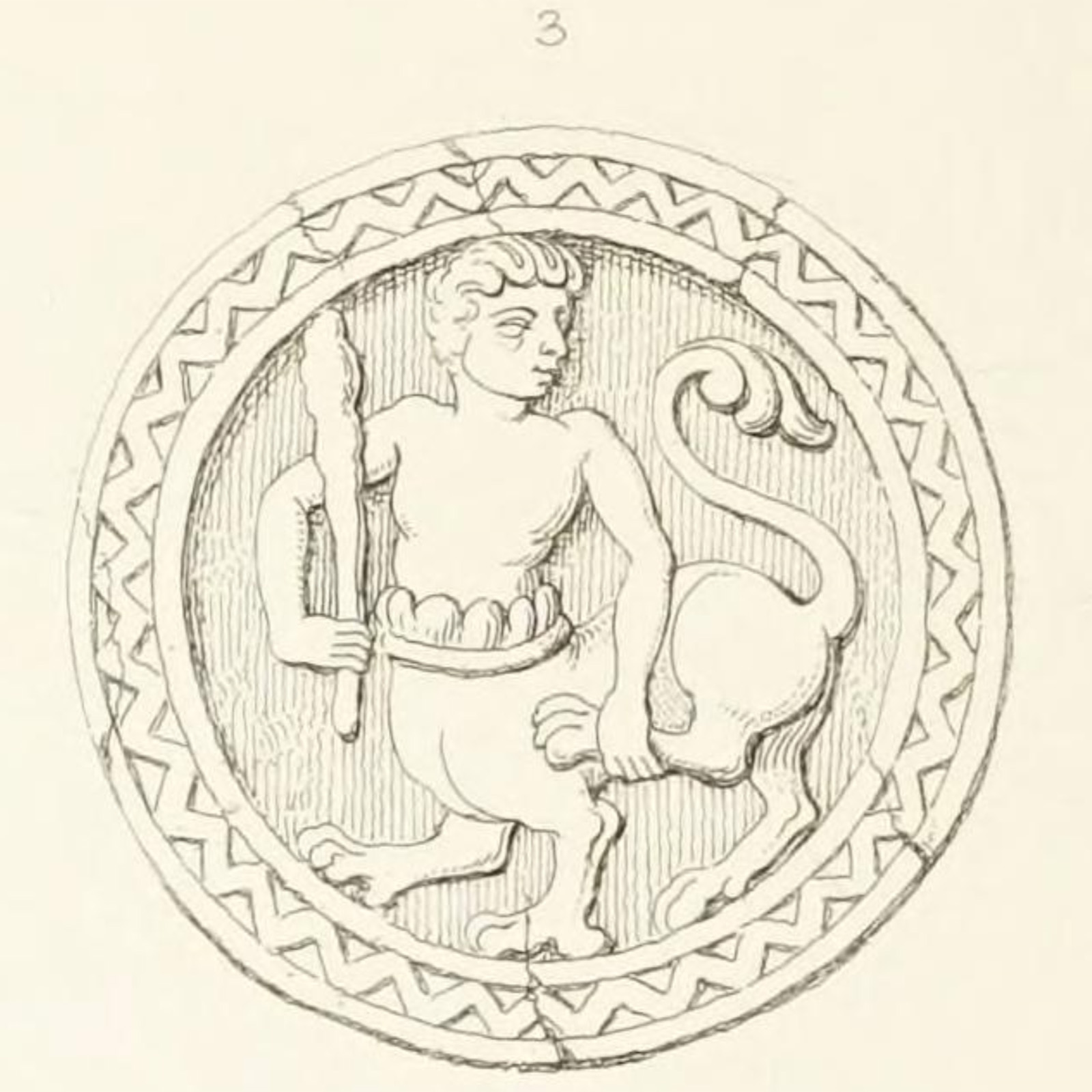
The actual devices of the Contorniati are perpetuated upon the early mediaeval draughtsmen, a conclusive evidence of the common nature of both; Gothic usage being only the antique barbarised and depraved. One in bone (Londesborough Coll.) referred to the tenth century, is engraved with a mounted archer in flat relief; another in walrus-tooth, probably of the twelfth, presents a lion centaur wielding a club. Both offer other points of resemblance to their Roman predecessors in their ornamental margins, and large diameter of 1 in. respectively.
Emphasis mine.
Evidently, the Romans liked to give out medals, like big coins, but not for use as currency. And in the 10th to 12th centuries, European crafters would make their own versions, carved in walrus ivory (often imported from Greenland). Arguably, this is not a medal at all, but maybe a game piece, and King is stretching it in his classification, or, more generously, making the case that these game pieces evolved from the Roman medallions.
The "Londesborough Coll." mentioned is a reference to the "Londesborough Collection." Per this webpage at the Nationalmuseet in Copenhagen, the collection was owned by Albert Denison, Lord Londesborough, 1805-1860, who was a wealthy English lord interested in archeology. A catalog of a portion of his collection was published privately in 1853, and another catalog was published in 1857. After his death, the collection was sold and broken up in 1888, and his posthumous papers were burned in 1924. His wife shared his interests.
I tracked down the 1853 book. The entire book is available online at HathiTrust, a digital online library: Catalogue of a collection of ancient and mediaeval rings and personal ornaments, written by Thomas Crofton Croker for Lady Londesborough. This book details only a subset of the Londesborough Collection, alas, not including the coin / medal / game piece we are looking for. However, item number 186 (page 68), a signet ring, is described as, "On the face is engraved an animal, something like a lion, with a human head, his tail coiled round the body. From Dean Dawson's collection." That's likely a sphinx, not a lion-centaur, but it seems interesting nonetheless.
The 1857 book is Miscellanea Graphica: Representations of Ancient, Medieval and Renaissance Remains in the Possession of Lord Londesborough, written and engraved by Frederick W. Fairholt, and published by Chapman and Hall, London. I found places to buy it at Rooke Books (for 475 pounds) and at Abe Books (for US$ 656.50). Fortunately for my wallet, I found the entire text online at the Internet Archive.
In the introductory essay of this work, I found this remarkable passage:
The magical or other virtues, which were supposed to exist in the things themselves, were believed, indeed, to be easily transferred to figures of those things, while to many combinations of figures were ascribed qualities that were equally marvelous. The engraved stones and cameos of the ancients, which were often found in digging upon Roman sites, were objects of great superstition in the middle ages, and were believed to possess qualities of the most singular description. "The superstitious eld" has left us many inventories of these qualities, from which we might easily make a numerous selection. Thus we are assured that a stone engraved with the figure of a sheep, or a lion, or of Sagittarius, carried on the person, renders a man "amiable and gracious towards everybody."
Emphasis mine.
But even more happily, this book DOES have a sketch and description of the medallion described by C.W. King! Here it is:
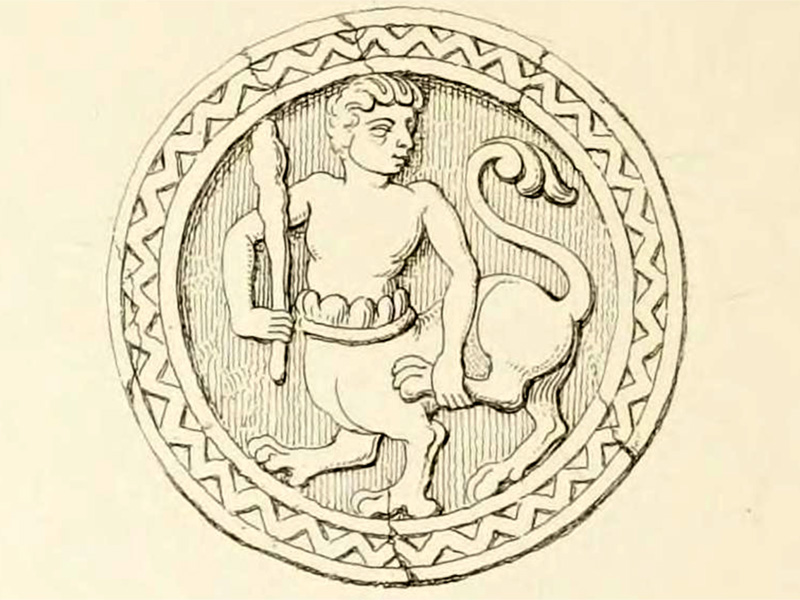
Look at those leonine paws, and that tail! Note how the "belt" echoes lions' manes drawn around the waists of other sagittaries of the era. And I love how he is holding his rear paw in his hand.
The text of the book reads: "Fig. 3. DRAUGHTSMAN, of walrus tooth, representing a fabulous monster bearing a club, within a chevron border. Probably executed in the twelfth century." Click the image to embiggen. This text only refers to our walrus-carved wemic as a "fabulous monster," so I really owe a debt of thanks to King for describing it as a lion-centaur! Without that, I would never have come to Fairholt's book.
But can we do better than a sketch? How about a photo? Where did this piece go after the collection was sold?
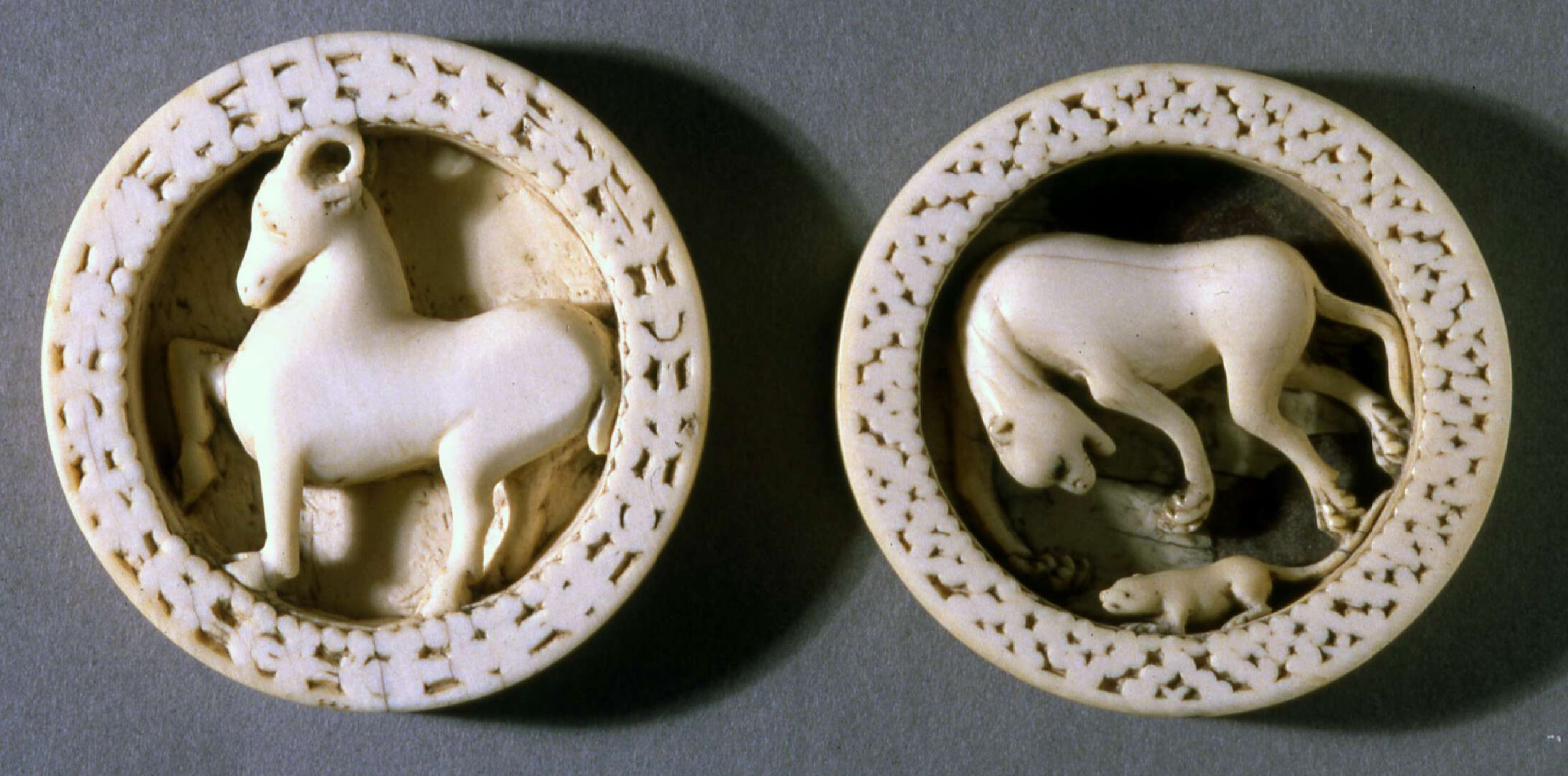
Parts of the Londesborough Collection, some 450 pieces, were purchased by (or donated to) the British Museum, such as this brooch. So I poked around the museum's online collection, but alas, did not find our walrus-ivory lion-centaur. So I do not actually know where our lion-centaur medallion is at present, nor do I have a photo. I did find a walrus-ivory medallion, or game piece, or "draughts-piece," as the museum calls it. It is not the one we are looking for, and not from the Londesborough Collection, but it gives an idea of what the lion-centaur piece might be like. Take a look:
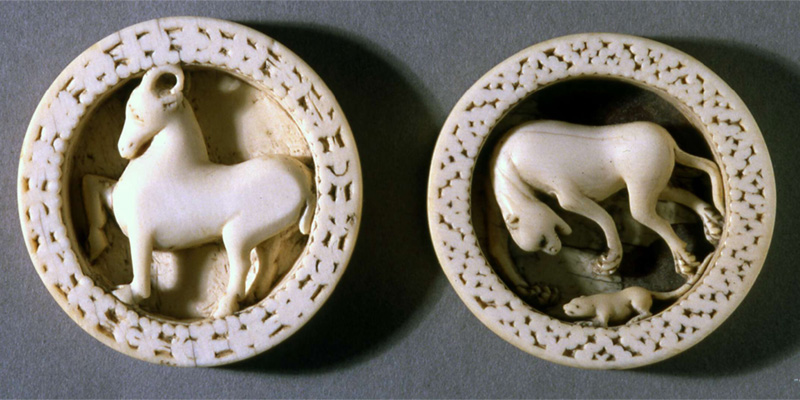
Look at the level of beautiful, minute detail here. In a piece just 58 mm (2.25 inches) in diameter! I wish I could see a similar photo of the ivory wemic.
The museum's page detailing this says, "Object Type draughts-piece, Museum number 1892,0801.33, Description Draughtsman; walrus ivory; circular, a horned animal, ram (?), Production date 12thC (late)."
Regarding the sphinx ring mentioned above, Fairholt mentions that Lady Londesborough's collection contained 250 ancient and medieval rings, but he describes only ten of those in his book. And that ten did not include the sphinx ring.
Postscript: I found another sagittary in the Fairholt, but I'll save that for another day.