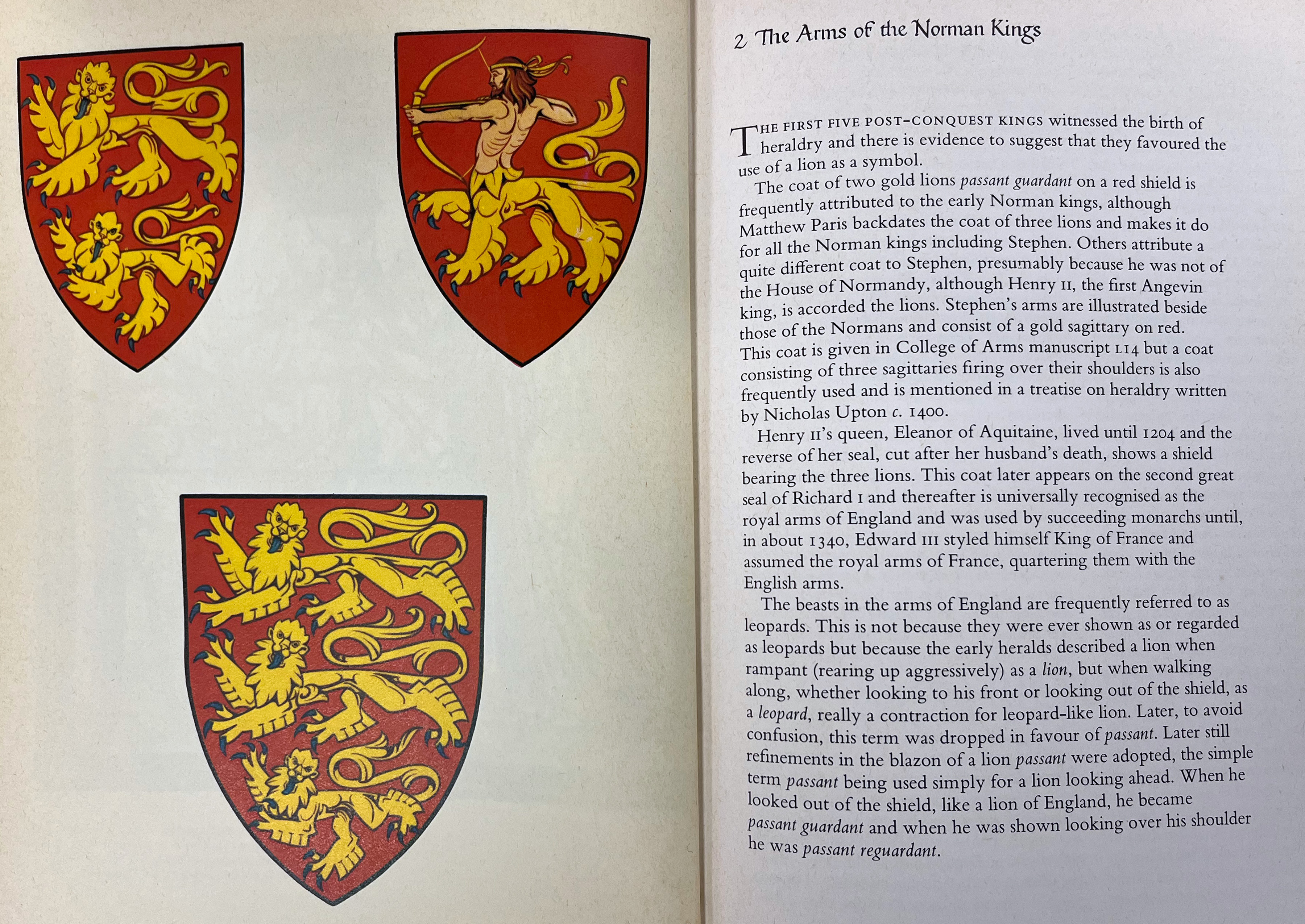
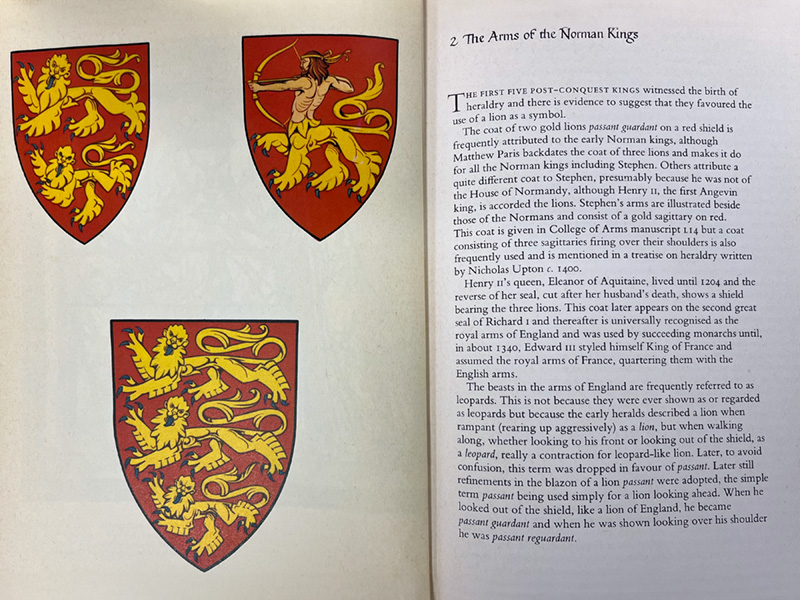
I've blogged, back in 2006, about King Stephen of England, with screen grabs of pages from a book on the topic I found online. I recently got my hands on the actual book, The lives of the Kings & Queens of England, by Antonia Fraser, originally published in 1977. Here are the pages in question (click to embiggen):
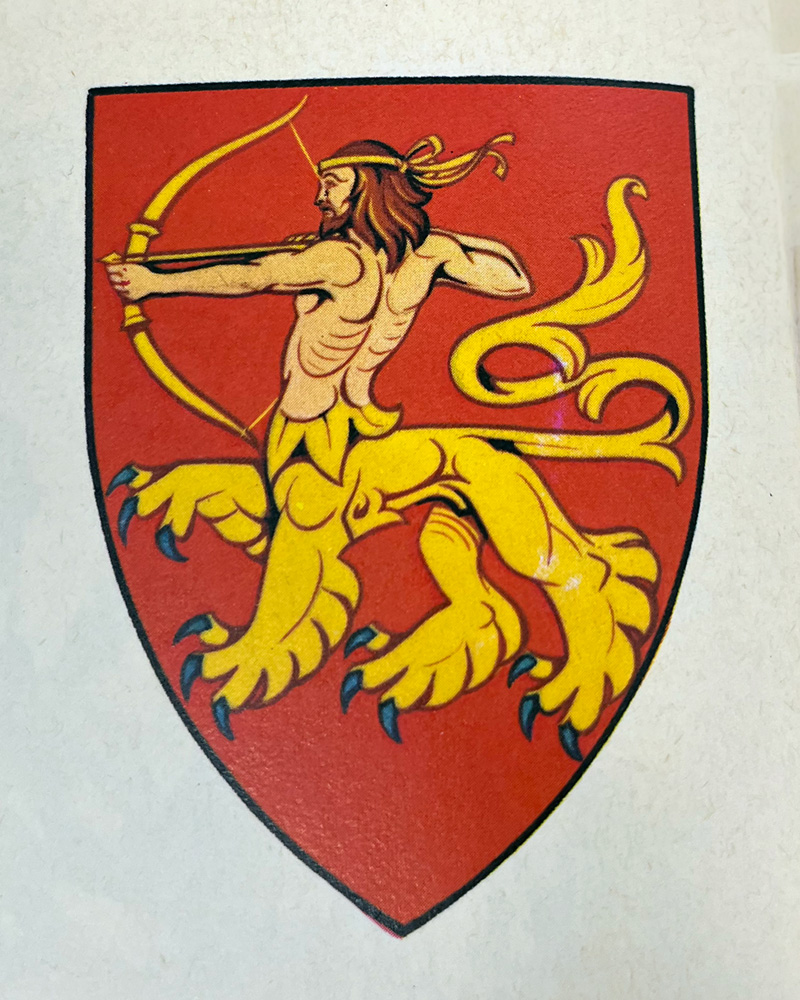
Here is a close-up of the leonine sagittary of King Stephen:
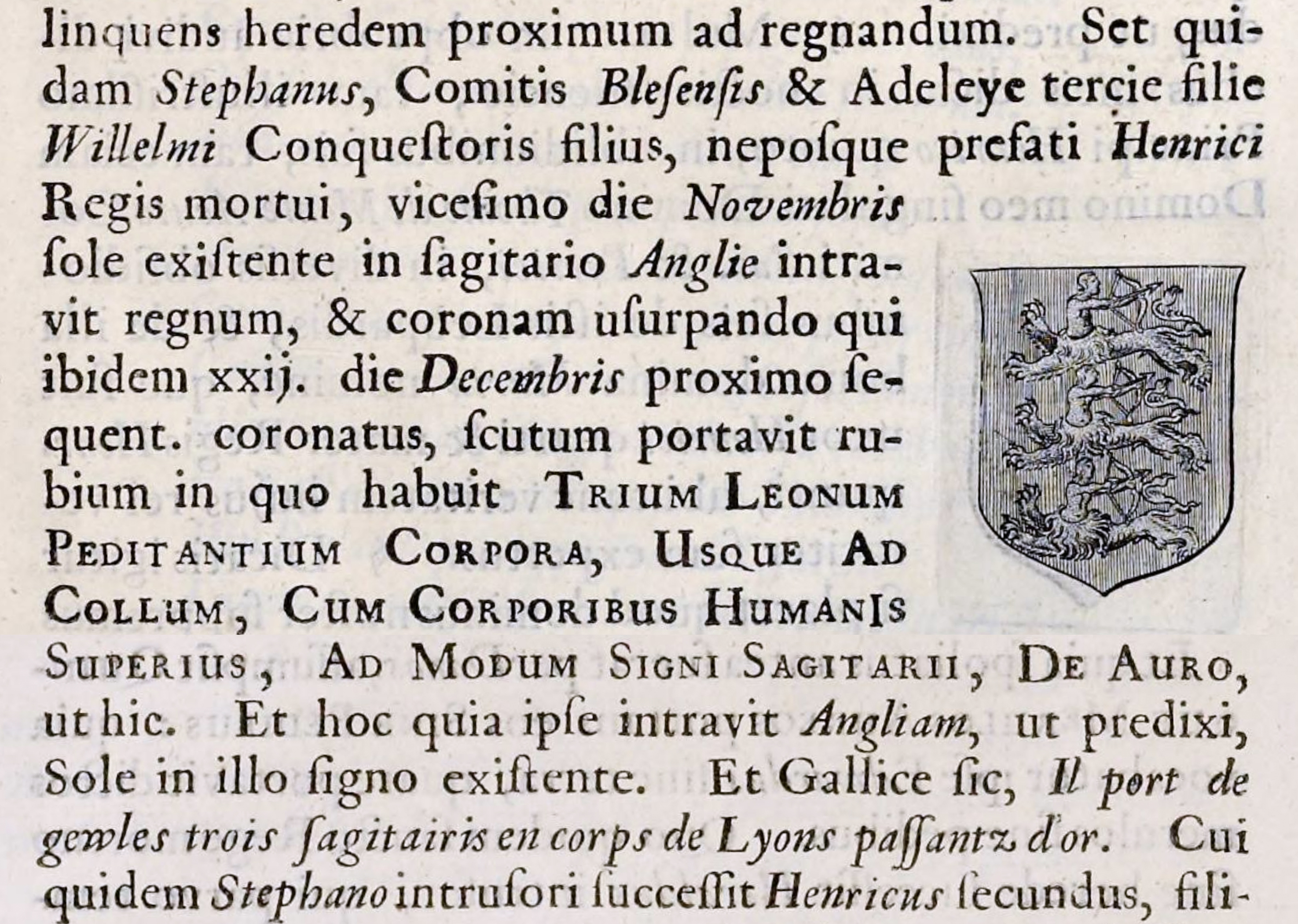
The text of the book references Nicholas Upton. According to Wikipedia, he was the author of Libellus de Officio Militari; it was dedicated to Humphrey, Duke of Gloucester, and written (in Latin) before 1446. A version was printed in 1654, in compilation with other works, listed in the Internet Archive as Nicolai Vptoni De studio militari, libri quatuor. Iohan. de Bado Aureo, Tractatus de armis. Henrici Spelmanni Aspilogia. This version, preserved photographically as a PDF, is available online, and on pages 129-130 of that edition can be found this remarkable passage (click to embiggen):
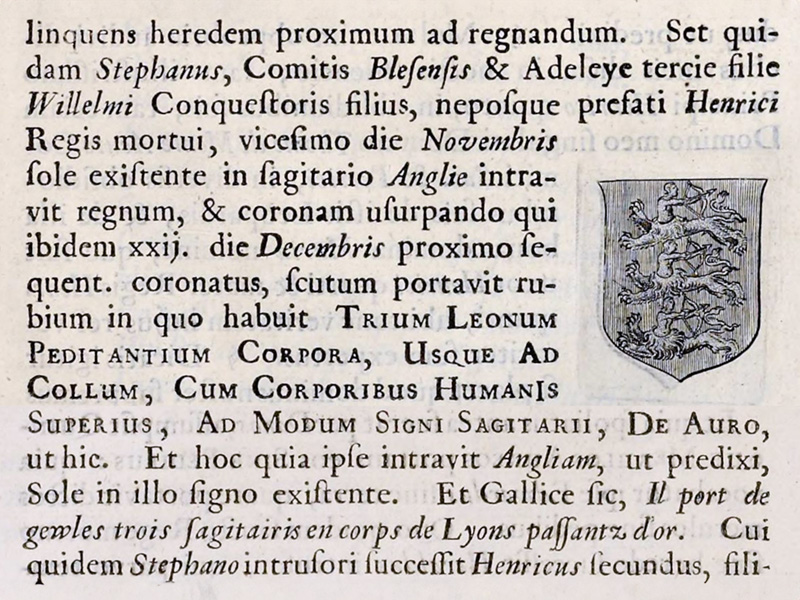
The portion of this passage that concerns the coat of arms of King Stephen can be translated as:
"But a certain Stephen — son of the Count of Blois and Adela, third daughter of William the Conqueror, and nephew of the aforementioned late King Henry — entered the kingdom of England on the twentieth day of November while the sun was in Sagittarius. Usurping the crown, he was crowned there on the twenty-second day of December following. He bore a red shield in which he had THE BODIES OF THREE LIONS WALKING, UP TO THE NECK, WITH HUMAN BODIES ABOVE, IN THE MANNER OF THE SIGN OF SAGITTARIUS, IN GOLD, as here. And this because he himself entered England, as I said before, while the Sun was in that sign. And in French thus: He bears on a red field, three sagittaries with the bodies of golden lions walking."
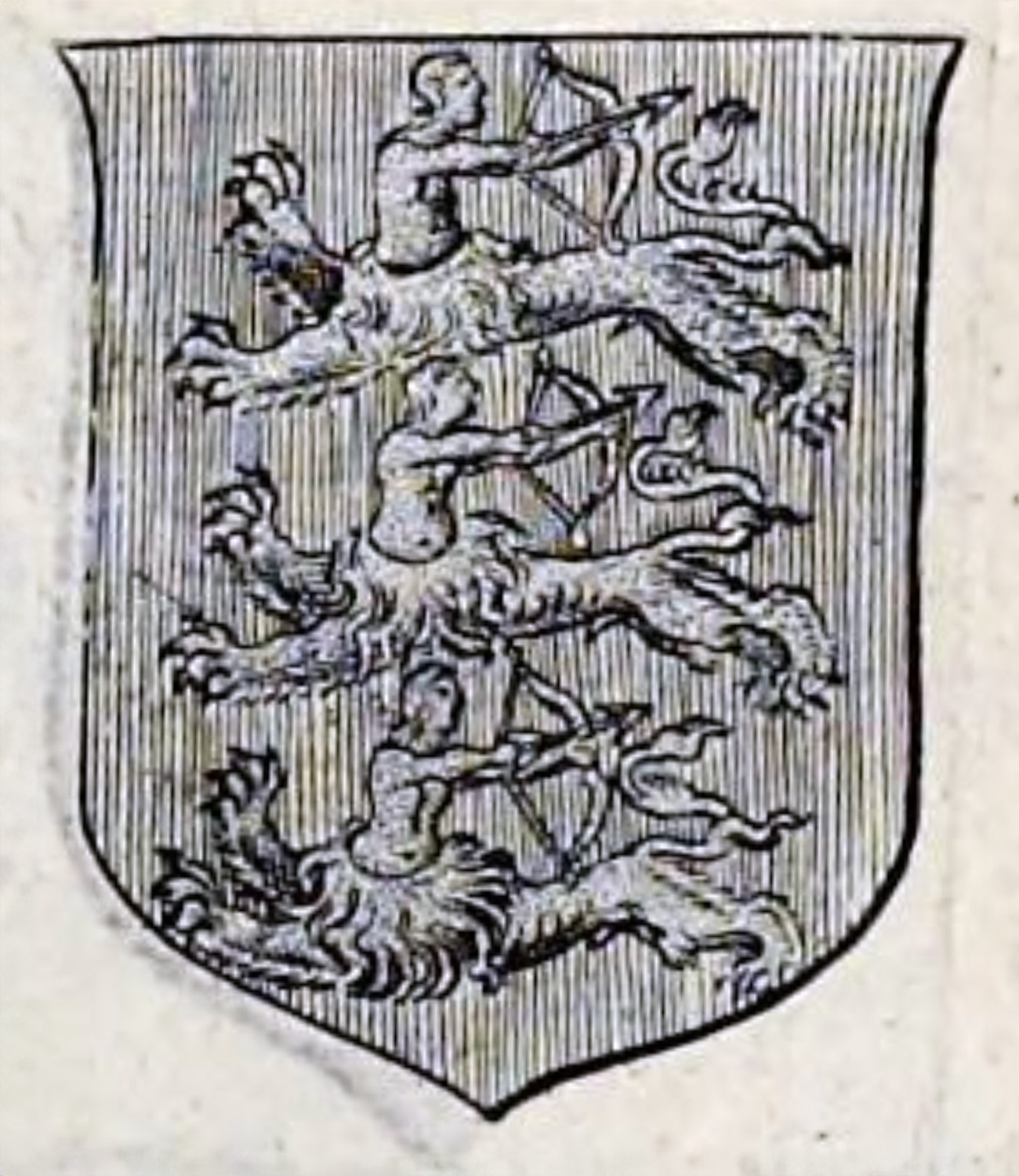
As you see, the vital all caps portion is in the original, emphasis by the author. It describes what Stephen's leonine sagittaries looked like. But we need not worry overmuch at what exactly Upton means in his text description, because he includes art (click to embiggen):
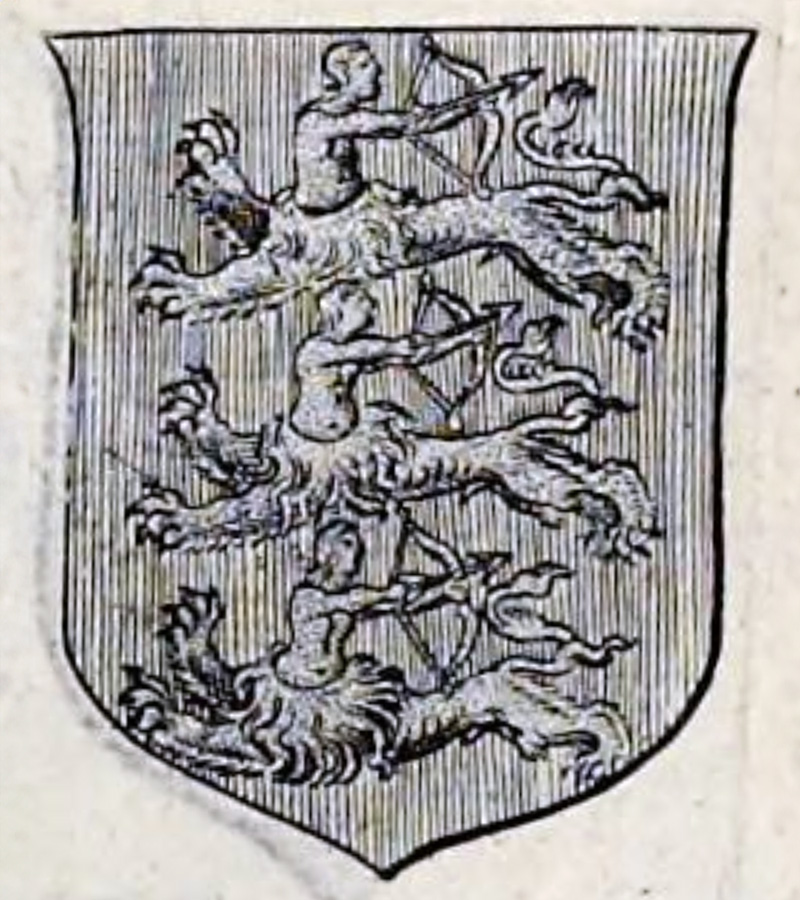
Look at the manes at the waist, the claws on the paws, the tufts on the tails. No equine features are to be seen. And the upper bodies are entirely human, not beastly.
Note that Upton's passage, immediately after describing Henry's leonine sagittaries, says, "And this because he himself entered England, as I said before, while the Sun was in that sign." The point is, Upton suggests that Stephen took these sagittaries as his emblem because he ascended the throne in the season of the constellation Sagittarius.
It is worth noting that other sources simply depict Stephen's sagittaries as plain centaurs, with equine bodies. See these pieces in the British Museum, here (in 1706), here (in 1677), and here (in 1622). Upton, writing in the 1440s, seems the source with the more genuine claim to accuracy, or at the least, to an older tradition.
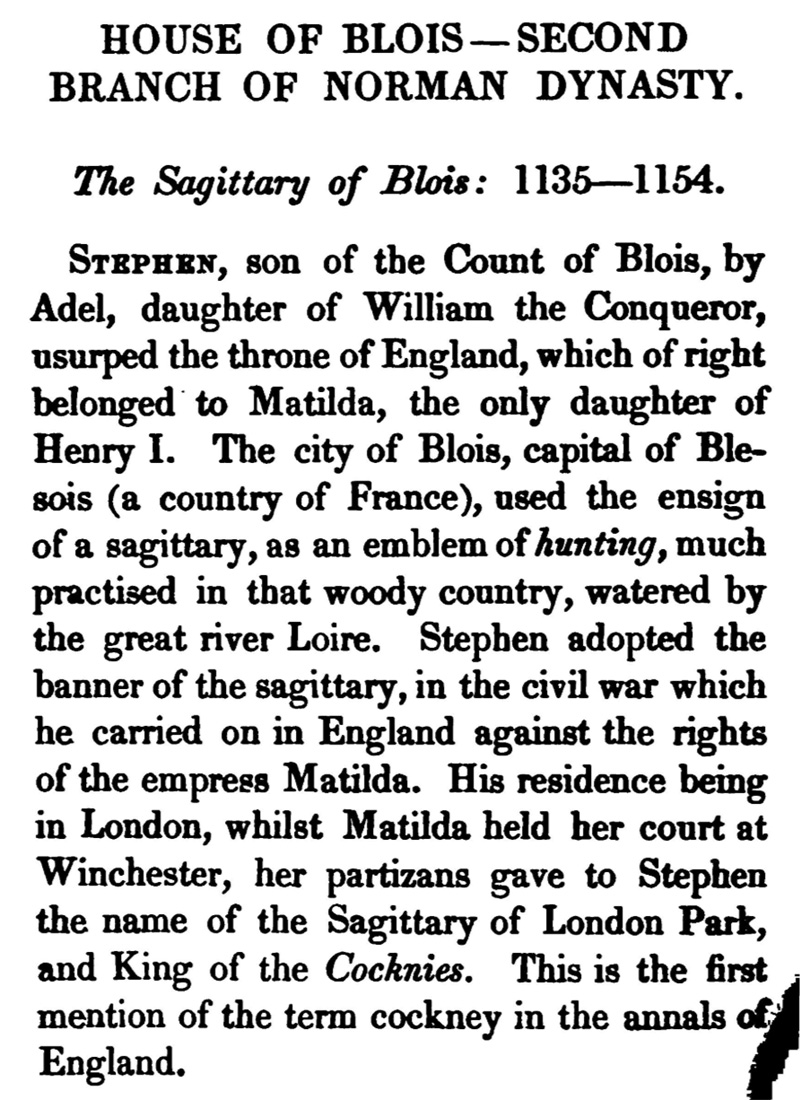
Regarding the reason that Stephen took these sagittaries as his own, I found a book of English heraldry, The Regal Armorie of Great Britain, written by Alexander Brunet and published in 1839. In it, there is this remarkable passage:
The Sagittary of Blois: 1135–1154.
"Stephen, son of the Count of Blois, by Adel, daughter of William the Conqueror, usurped the throne of England, which of right belonged to Matilda, the only daughter of Henry I. The city of Blois, capital of Blesois (a country of France), used the ensign of a sagittary, as an emblem of hunting, much practised in that woody country, watered by the great river Loire. Stephen adopted the banner of the sagittary, in the civil war which he carried on in England against the rights of the empress Matilda. His residence being in London, whilst Matilda held her court at Winchester, her partizans gave to Stephen the name of the Sagittary of London Park, and King of the Cocknies. This is the first mention of the term cockney in the annals of England."
Now, that said, I can find no prior references either to the sagittary as associated with Blois, or to the phrase "Sagittary of London Park." It may be that these were actually fabulations from thin air by Brunet or other heraldists of the time.
Note that Upton does not use the mocking "Sagittary of London Park" phrase, and attributes the use of the sagittary to the time of year in which Stephen came to England to take the throne.
Another theory as to the origin of the heraldry can be found in The British Herald, by Thomas Robson, in 1830. He says:
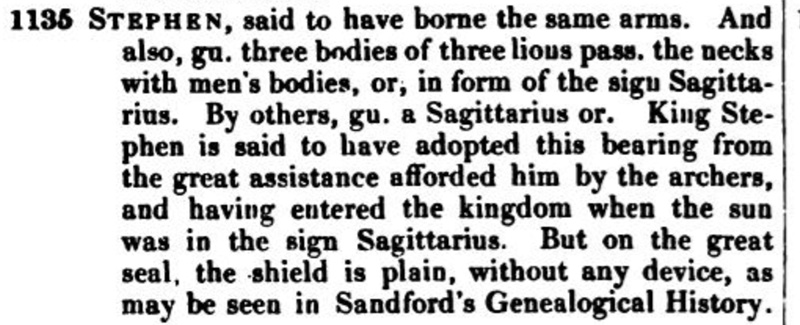
This posits that the choice was based on the time of year, but also to honor the archers who helped Stephen secure his crown.
One more possibly relevant point ... William I, William II, and Henry I, the kings before Stephen, are represented in heraldry by leopards, or lions. After Stephen, the kings of England returned to lions. It may be (and this is my own hypothesizing), that Stephen's sagittary is leonine because it hearkens to this tradition.
Finally, though it adds little to no new information, let me mention Fictitious & symbolic creatures in art with special reference to their use in British heraldry,
by John Vinycomb, published in 1906. In a chapter on sagittaries and centaurs (pages 141-147), he takes note of Upton's work and mentions leonine sagittaries in passing.
I think this entirely settles the topic of King Stephen and his heraldry. Note that Stephen's son and heir died young, and so ended his line, and the throne went to the descendants of Matilda. I wonder, if Stephen's son had lived and the line continued through him, if sagittaries would have been more well known. As it was, their use, in heraldry at least, started and ended with Stephen.