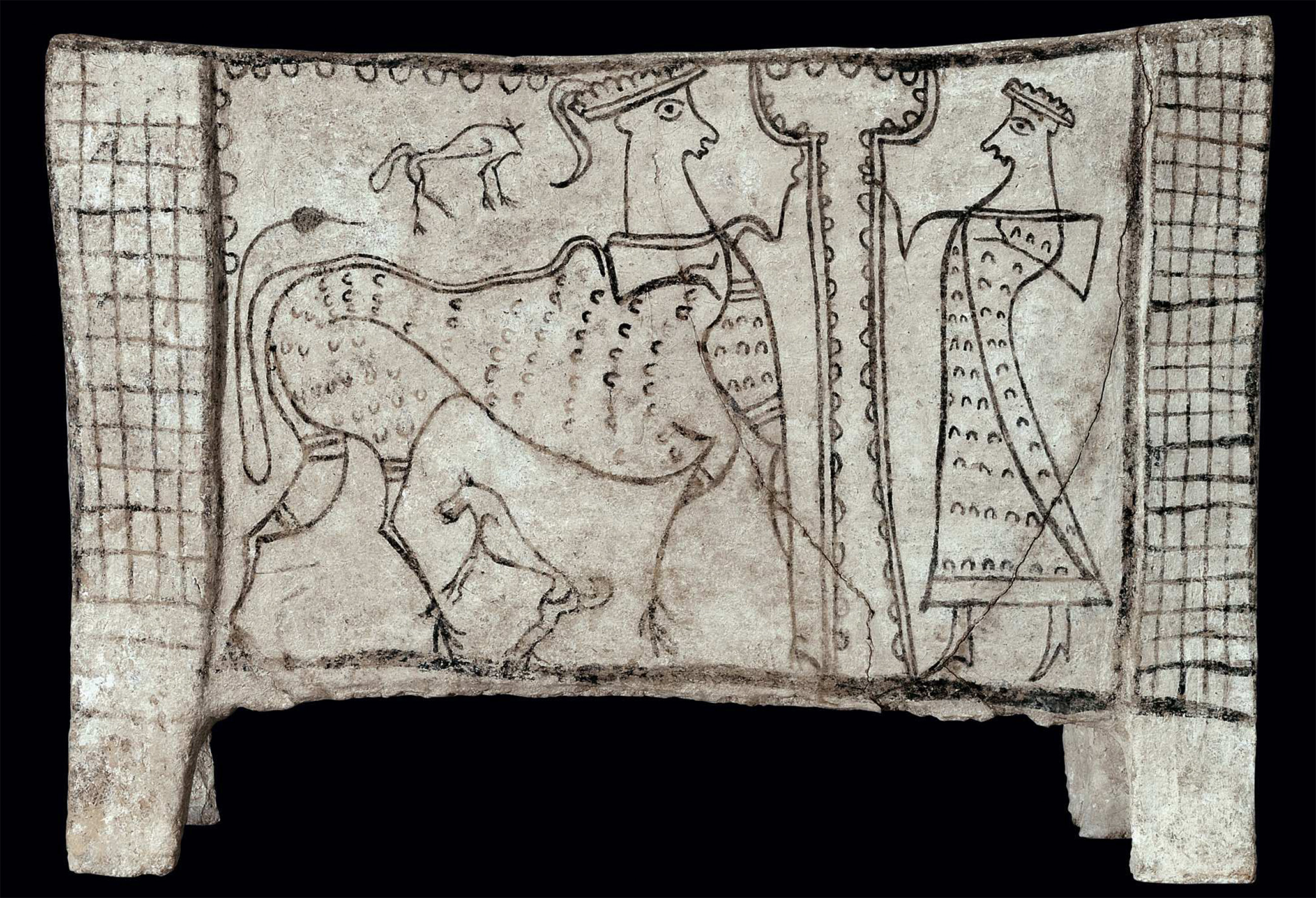
In Crete and in Mycenaean Greece, burials consisted of tunnels carved into soft limestone bedrock, then a chamber, into which the body was placed with gifts. In Crete, and in at least one location on the mainland (a place called "Tanagra"), the body was placed in a clay coffin, called a "larnax," plural, "larnakes." These coffins, like sarcophagi with stubby legs, were decorated with scenes. Often, these scenes would show mourners wailing in grief. Also, there were images of priests, and of creatures meant to represent guides bringing souls to the afterlife.
For more on these larnakes in Tanagra, check out this draft of an academic paper: The Tanagra Larnakes: Iconography, Style, and Interpretation, by Georgios Spyropoulos. The photos really get the idea across.
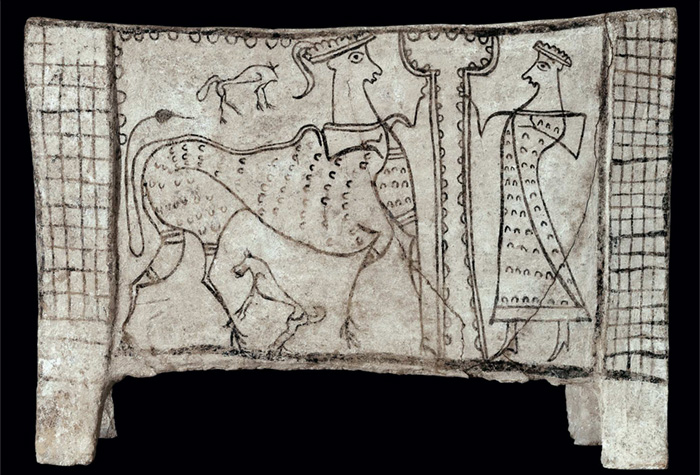
Well, as it turns out, the images of spirit guide creatures include sphinxes. And at least one of the sphinxes pictured has arms. In my book, that makes it a lion-centaur, that is, a wemic. Here is a photo of the wemic larnax (click to embiggen):
Archaeologists like to make line drawings of the art that they find, which is really useful when the image is hard to make out. This one is very clear, but here's a line drawing anyway:
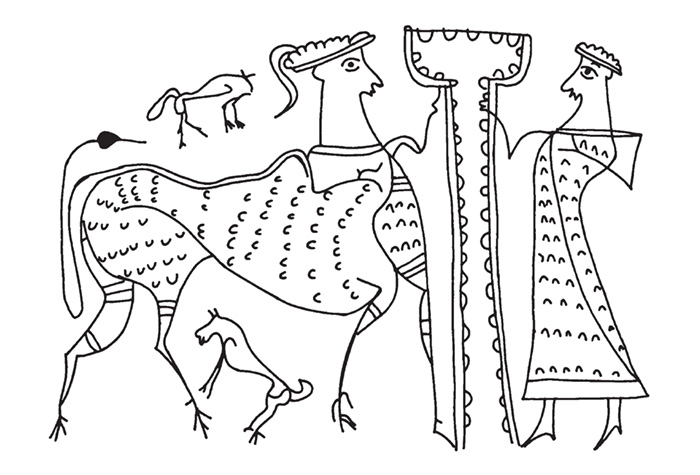
Now, I'll grant you, to a modern eye, this creature really does not have much of a torso, and its neck is way long, and its arms and legs are spindly. But to a mourner in Ancient Greece, this was a comforting sign that spirits would take your loved one home.
I found these images in another academic work, Mourning On The Larnakes At Tanagra: Gender and Agency in Late Bronze Age Greece, by Margaretha Kramer-Hajos. For context on the importance of sphinxes in funerary practices in Mycenaean Greece, circa 1,300 BCE, here is an extended quote from her article:
Scenes that transcend the immediacy of the real world are rare.
Scenes with sphinxes are most common in this category: there are six
examples on five larnakes. Sphinxes, featured in the
Archaic period on grave stelai, may be viewed as guardians of tombs and
conveyers of the dead, or as representations of the liminality between life
and death. Birds, often viewed as omens as early as the Homeric epics
and certainly in Classical Greece (the eagles in Aeschylus's Agamemnon are
a famous example) are, as messengers from another world and creatures
moving freely between the land and the skies, similarly "in between." The
presence of sphinxes and huge birds could thus equally allude to a journey
of the soul to the afterlife, or to the afterlife itself, as has been proposed for
Minoan scenes featuring humans in the company of fantastic creatures and
large birds. Men — or, on one occasion, women — accompanied by sphinxes
or large birds are therefore placed in a liminal or otherworldly position.
For that reason, robed male figures in the company of a sphinx have
been interpreted as priests negotiating the transition between the world
of the living and that of the dead.
Another scholar writes about this exact image, in "Death and the Tanagra Larnakes," by Sara Immerwahr, which is chapter seven of a book, The Ages of Homer, edited by Jane B. Carter and Sarah P. Morris. Immerwahr clearly identifies the figure as a lion-centaur:
A single figure in an elaborate bordered robe approaches from the right and is met by a large sphinx coming from the left. The sphinx is wingless, and equipped with human arms (as well as four legs!); both figures touch a column, and both wear the flat cap characteristic of sphinxes, the sphinx's with the usual floating plume. The association of the sphinx with death in the iconography of the larnakes is not limited to this example, which is, however, the most compelling in its suggestion of the sphinx as a guardian of the house and tomb, a role it was destined to play in Archaic Greece.
Immerwahr thinks it is remarkable that this sphinx has two arms and four legs. She even uses an exclamation point, which, in scholarly writing, is like setting off a loud firecracker. I think it's remarkable, too, especially as this is only the second unambiguous Greek wemic I have found. (The other one is here.)