A long time ago, 22 years ago, actually, I first blogged about the Ancient Assyrian Urmahlullu, after a professor I emailed told me about Mesopotamian Protective Spirits, a seminal book by F. A. M. Wiggerman. I recently found the entire book, available for free at the wonderful Internet Archive.
A very very very long time ago, 2,600 years ago, maybe, artists carved urmahlullus into the walls of a palace at Nineveh. Wiggerman gives us a great depth of detail on these creatures.
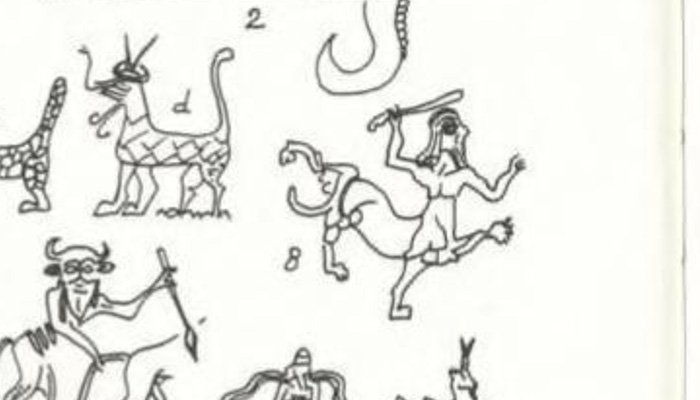
Above: A lion-centaur taken from Wiggerman's book, page 188.
I found information about the author on this Einstein Center web page: Frans Wiggermann is Professor (Emeritus) of Assyriology at the Vrije Universiteit (VU) in Amsterdam. He is a worldwide expert for Semitic languages, Iconography and Demonology of the ancient Near East. He defended his Ph.D. dissertation at the VU in 1986, and the resulting book, Mesopotamian Protective Spirits: The Ritual Texts has become a classic in the field.
Let me quote Wiggerman's entire entry on the topic of greatest interest to me:
urmahlullu, "Lion-Man"
Word: composed out of ur-mah, "lion" and lu-ulu, "untamed man" The urmahlullu is extremely rare. It is omitted thrice in enumerations of the trophies of Marduk, and its first appearance in art is on a MAss seal. Possibly, therefore, the loan word is a learned neologism, based on the analogy with kululla or girtablullu.
Identification: unwinged lion-centaur. This identification was first proposed by Ellis (Essays Finkelstein) on the basis of a badly broken lion-[centaur] inscribed as prescribed for the urmahlullu .... The identification was later confirmed by the appearance of the same text on a perfectly preserved monumental specimen from Ashurbanipal's palace. Whether winged examples [on seals] are also called urmahlullu cannot be decided. The lion-demon or the human-headed lion-man are sometimes mistakenly identified as urmahlullu. There is no connection with priests clad in lion's skins or wearing lion masks. Reade proposed kuribu for the unwinged lion-centaur.
Mythology/Attestations: The first attestation of an unwinged lion-centaur on a 13th century Assyrian seal predates its inclusion among the trophies of Marduk; it is not yet present in Ee (VII.B.9), telling, since this text enlarged the number of monsters with traditional names. Thus the lion-centaur does not seem to have had a function in traditional mythology. It was invented in the late second millennium, probably by analogy with the centaurs (not necessarily in Assyria, since winged lion-centaur also existed in the South), named by analogy with kululla or girtablullu, and functioning in mythology only after its inclusion among the trophies of Marduk.
Apotropaic representations: The position of the unwinged lion-centaur on reliefs and as a clay figure may correspond to the position prescribed in the ritual, in the bathroom.
Elsewhere in the book, he says, The only figure that is perhaps associated with a specific room is the urmahlullu (cf p. 98). He bars, according to the inscription on his sides, the (entry of the) Supporter-of-Evil and perhaps also (?) of Sulak, a demon active in the bathrooms that he guards.
Wiggerman talks more about the ablution room connection:
Ritual IMI prescribes an urmahlullu for the gate to the lavatory. The urmahlullu of the north palace are in rooms that may very well be lavatories, connected with the niche characteristic for bathrooms and called ablution suites by Turner. The spot where the only clay urmahlullu was found in a site is unfortunately not known, but it may have been at the niche excavated in the same house. Certainly not all bathrooms of Assyrian palaces (and houses) were protected by urmahlullu. If correct, the connection of the urmahlullu to bathrooms is striking; other figures do not seem to guard specific rooms. The unique position of the urmahlullu is matched at the side of evil by an equally striking phenomenon: a demon housing especially in lavatories, Sulak. According to the description of Sulak in the "Unterweltsvision," this demon has the appearance of a regular lion. Is the Lion-man (urmahlulla) installed in the bathroom to guard it against attacks of the lion demon Sulak? In fact, on one of the very few seals showing an urmahlullu, we see him attacking a lion.
Note: Throughout this screed, I have "cleaned up" the quotes for readability. Please go to the original text, especially for citations and references. Also, I have used "urmahlullu," although the term might be more accurately rendered like this: urmaḥlullū
Check out more screeds on urmahlullu.

