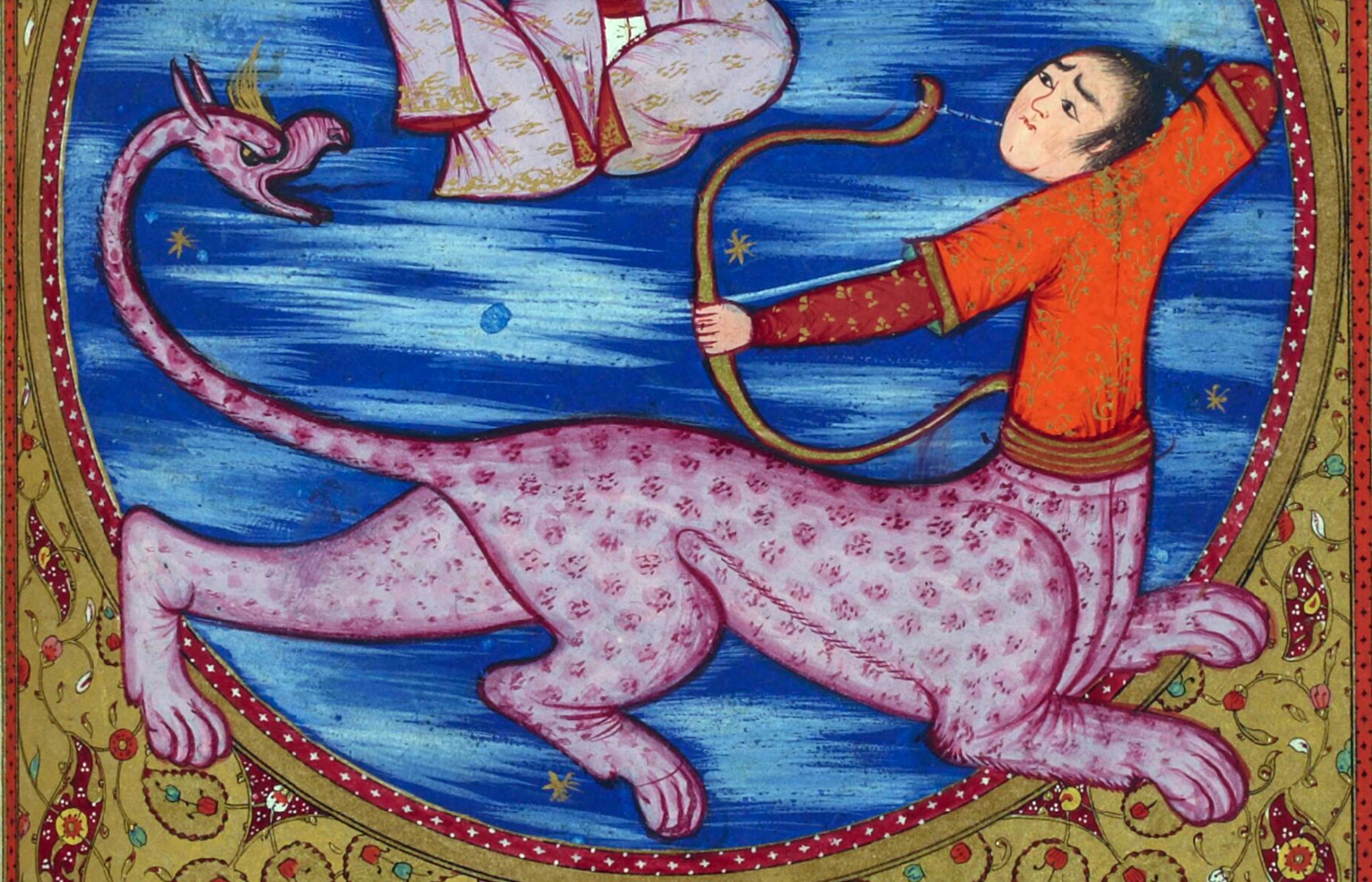
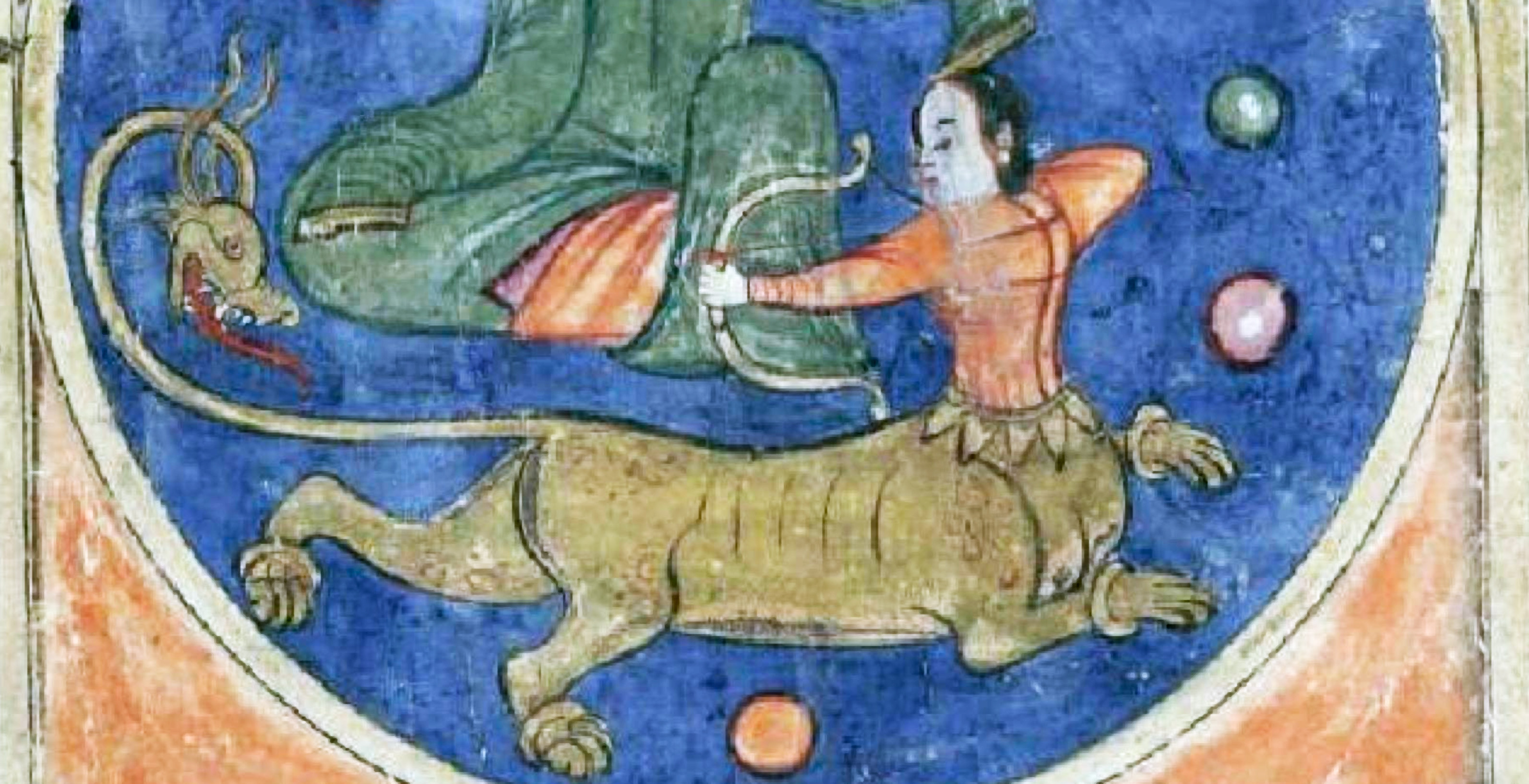
The invaluable Dorothea McEwan, who I cited recently for her research on Ethiopian sagittaries, also mentioned the mythical creature in an Arabic context. In her article, "Sebetat: the many lives and deaths of a monster," published in the Journal of Ethiopian Studies, Vol. 40, No. 1/2, she says this:
The Sagittarius of the zodiac, the archer, drawing his bow, is at times half man and half horse. At other times, the body is not horse-like but with thick legs and paws and sometimes even spotted fur, like a lion or leopard. The creature is called
al-qaws in Arabic, 'bow'. A magnificent example showing the archer on a lion's body is found in The Book of Felicity [Fig.10]. Commissioned by Sultan Murad III, the codex was written in the second half of the 16th century; it features descriptions of the twelve signs of the zodiac.
She is referring to this wonderful image:
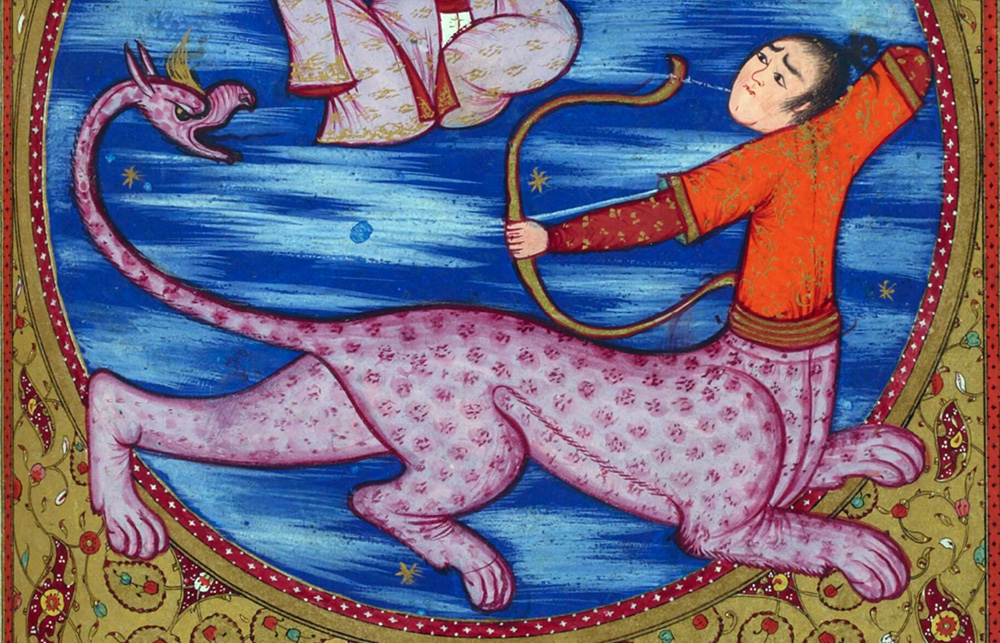
This is a true sagittary, except for the dragon-head tail! McEwan talks about that, too:
Islamic artists started to represent the head of the dragon in the exaltation of Sagittarius. Astrologers came to interpret the 'dragon' as another planet, or pseudo-planet, and it was in the first instance particularly associated with Sagittarius, also with Gemini. Sagittarius was thus frequently depicted looking back toward his tail, and the tail was drawn as a knot with a dragon's (or snake's) head at the tip. It has also been maintained that whenever the tail of a centaur is depicted as a tail having a snake or dragon's head with an open mouth at the tip, the reference is to the lunar node called the 'tail of the dragon', whose exaltation was thought to be in Sagittarius.
This is interesting, because it links a leonine sagittary to the zodiacal Sagittarius. But also, look at the art, which is, as McEwen says, "magnificent." I love the expression on the fellow's face. He seems dismayed to be shooting at his own tail.
The Book of Felicity, by Osman the Miniaturist, is available online at the Bibliotheque nationale de France's Gallica website. It was commissioned by Sultan Murad III, who ruled the Ottoman Empire from 1574 to 1595. The book dates to 1582, per Gallica.
Of even more ancient provenance is the Kitab al-Bulhan, or Book of Wonders, an Arabic manuscript dating mainly from the late 14th century A.D. and probably bound together in Baghdad during the reign of Jalayirid Sultan Ahmad (1382-1410). It was created by by Abd al-Hasan Al-Isfahani. It's available on the Internet Archive, which dates it to 1390. Click to embiggen.
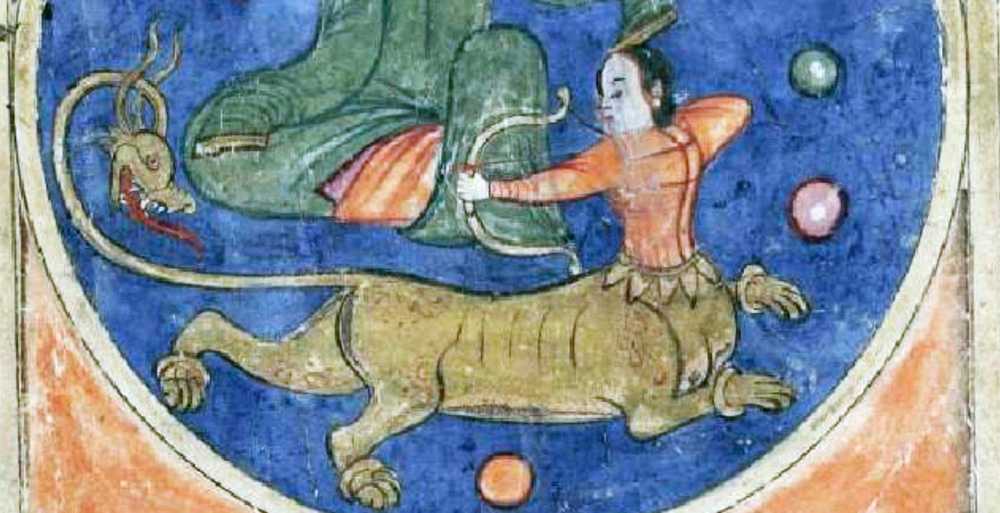
Given how similar these two works are in pose and subject matter, I can't help but think this represents an existing tradition, and/or that the artist of the later work had seen the older one.
Wikipedia has an article on the Book of Felicity and an article on the Book of Wonders.